

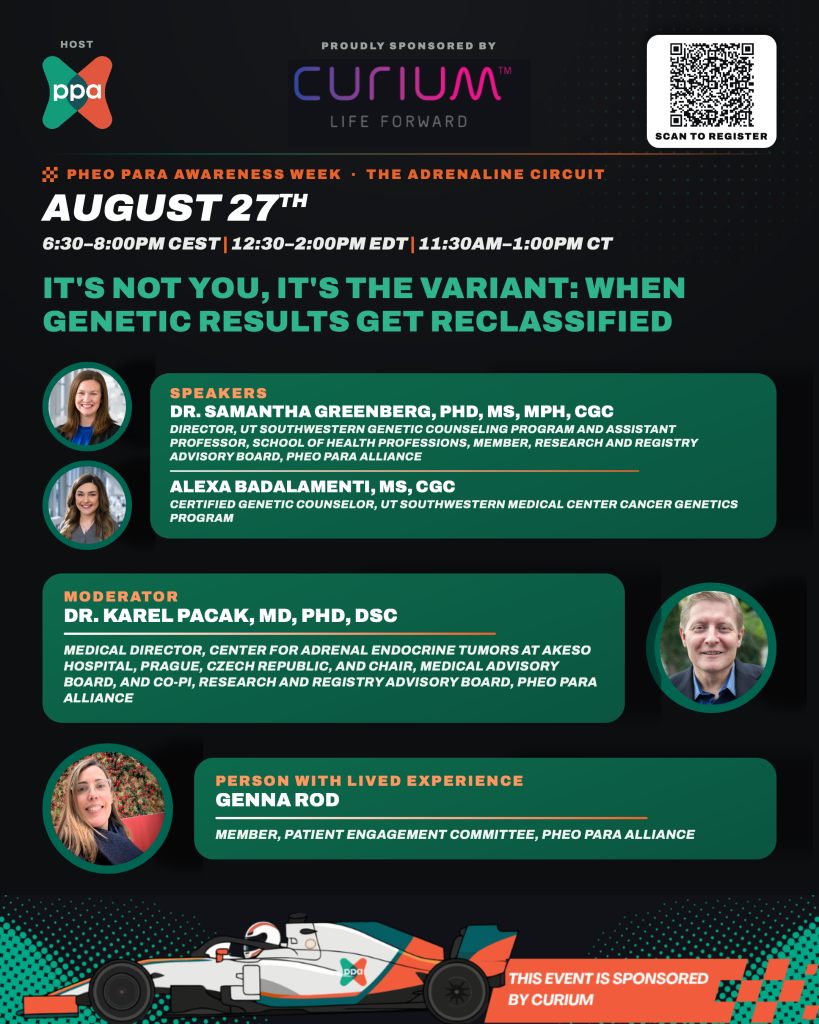
It’s Not You, It’s the Variant: When Genetic Results Get Reclassified
A Pheo Para Alliance (PPA) Educational Webinar, Sponsored by Curium, & Presented in Partnership with UT Southwestern’s Pheochromocytoma and Paraganglioma Clinical Center of Excellence
During the 7th Annual Pheo Para Awareness Week – August 24th-28th
Featuring Samantha J. Greenberg, PhD, MS, MPH, CGC, Director, UT Southwestern Genetic Counseling Program and Co-Director, UT Southwestern Paraganglioma Program
- Moderated by Dr. Karel Pacak, Pheo Para Alliance’s Medical Advisory Bpard Chair
- Person with Lived Experience is Denise Samocki, Pheo Para Alliance’s Patient Engagement Committee Chair
Session Description
Genetic test results do not always stay the same. As scientific research advances and more individuals undergo testing, new data may lead to reclassification of previously reported genetic variants—including variants of uncertain significance (VUS). These changes can influence personal health decisions, clinical management, surveillance recommendations, and family planning conversations.
In this session, Dr. Samantha Greenberg and a colleague will explain why genetic classifications evolve, what reclassification means for patients and families, and how healthcare teams can support clear communication and appropriate follow-up. The discussion will focus on reducing uncertainty, strengthening patient-provider communication, and supporting informed decision-making as genetic knowledge continues to grow.
Learning Objectives: At the conclusion of this activity, participants will be able to:
- Describe why genetic test results can change over time, including the scientific process behind variant classification and reclassification.
- Explain the meaning of key classification categories, including pathogenic, likely pathogenic, variant of uncertain significance (VUS), likely benign, and benign.
- Understand what reclassification may mean for personal health, monitoring, and treatment decisions.
- Recognize how reclassification may affect family members, including cascade testing and risk communication.
- Apply patient-centered clinical workflows to ensure individuals and families are informed when results change, including documentation, communication timing, and referral to genetics professionals.
- Use clear, compassionate communication strategies to reduce anxiety and uncertainty related to evolving genetic information.
- Identify appropriate next steps when a variant is reclassified, including when additional testing, monitoring changes, or no action is required.
- Develop practical questions to ask genetic counselors and healthcare providers when results are updated.
Thank you to our sponsor, Curium!

Watch the Recording Below